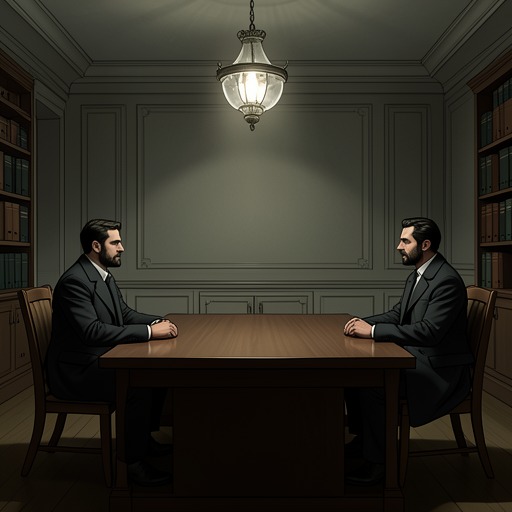
Interchangeability of identity
American PsychoInterchangeability of identity is one of the novel’s central conditions of perception. In the world inhabited by Patrick Bateman, people become difficult to distinguish because they occupy the same professional spaces, wear the same expensive clothes, cultivate the same bodies, and perform the same polished social rituals. The resulting confusion is not merely comic misrecognition. It exposes a society in which identity has become a marketable surface and in which status markers are more legible than individual character.
A Social World Built from Replicas
The most direct instance occurs when Timothy Price and Preston look across a bar and dispute the identity of a man. Price identifies him as Paul Owen, while Patrick Bateman insists that Paul Owen is elsewhere, on the other side of the bar. Owen then stands at the bar in a double-breasted wool suit, turning the scene into a visual demonstration of duplication: two men can occupy the same social field while appearing interchangeable enough to provoke disagreement about who is actually present.
The confusion becomes more consequential when Paul Owen mistakes Patrick Bateman for Marcus Halberstam. The mistake seems understandable within the office culture of Pierce & Pierce: Marcus works there, performs the same job as Bateman, favors Valentino suits and clear prescription glasses, and even shares Bateman’s barber at the Pierre Hotel. Owen’s error therefore does not result from simple carelessness. It follows the logic of a system that has reproduced its male professionals so successfully that names become less reliable than a cluster of interchangeable commodities and habits.
A similar misrecognition appears at Evelyn Richards’s Christmas gathering, where Owen greets Bateman as Marcus. Bateman responds within the mistaken identity rather than correcting it, addressing Owen as though the exchange were natural. The social encounter proceeds because recognition is unnecessary; the correct name matters less than the expected role, the familiar appearance, and the shared performance of professional ease.
The Surface as Identity
Bateman’s business-card competition makes the same structure visible through objects. He presents his new card from a gazelleskin wallet bought at Barney’s and waits for the group’s reaction. David Van Patten produces a card of superior elegance, described through its eggshell stock and Romalian type, and Bateman experiences a brief surge of jealousy before offering an outwardly controlled compliment. The cards function as miniature identities: each man’s status is condensed into design, typography, expense, and the ability to provoke envy.
The exchange shows that distinction in this society is produced through increasingly narrow variations on the same form. Bateman and Van Patten are not establishing individual selves so much as competing over refinements of a shared professional image. Their cards promise uniqueness, yet their very purpose is comparison. Identity becomes a surface that must be continually upgraded, displayed, and measured against another nearly identical surface.
This logic extends to Bateman’s membership at Xclusive, a private health club four blocks from his apartment on the Upper West Side. The club has been remodeled three times in two years and offers an immense catalogue of machines, courts, classes, evaluations, treatments, and amenities, with annual membership costing five thousand dollars. Bateman’s body is treated as another carefully managed credential. Before entering the gym, he adjusts his hair with mousse, applies moisturizer, and covers a blemish with Clinique Touch-Stick; even exercise begins with inspection and correction of the visible self.
Misrecognition Beyond the Elite
The interchangeability of identity also governs Bateman’s encounters outside the professional and affluent world. A woman from his building recognizes him in a public place and greets him warmly as Patrick. Bateman has seen her lingering in the lobby and looking at him admiringly, yet he has no idea what her name is. He offers a hesitant greeting, mumbles something resembling a woman’s name, and stands unable to sustain the encounter. She recognizes his public identity, but he cannot recognize hers, revealing that the polished self he presents is more memorable as an image than as a participant in reciprocal human knowledge.
The same failure of recognition structures Bateman’s view of the homeless man and his dog, Gizmo, on Twelfth Street. The man lies in the doorway of an abandoned antique store beside a shopping cart bearing the sign that he is hungry and homeless. Gizmo is initially overlooked; Bateman notices the dog only after circling the block and returning. The homeless pair are first encountered as part of the street’s refuse, indistinguishable from garbage bags, bottles, newspapers, and other disregarded matter. Their individual names and histories struggle to become visible within the social categories imposed upon them.
That encounter is later echoed on Fifth Avenue, where Bateman recognizes a blinded beggar he has previously injured. The man holds a sign claiming to be a Vietnam veteran and asking for help, while the wounds inflicted by Bateman remain visible beneath his sunglasses. The beggar’s asserted identity is treated by Bateman as another claim to be tested rather than as a human history to be heard. The scene reverses the earlier anonymity: Bateman recognizes the victim, but recognition brings neither accountability nor restoration. Identity is exposed as something that can be assigned, doubted, staged, or denied according to the observer’s power.
The Narrator Within the Pattern
Bateman is both analyst and product of this culture of interchangeability. He notices the repeated visual formulas around him—slicked-back hair, suspenders, horn-rimmed or similar glasses—and often encounters people who look like someone else. Yet his own narration reveals that he is equally dependent on surfaces. Clothing, grooming, business cards, club membership, cash, and branded goods organize his sense of control, while his inner life remains unstable and increasingly difficult to separate from his performed professional persona.
His reaction to being mistaken for Marcus is especially revealing because he does not feel genuinely threatened by the error. Since Marcus does the same work and resembles him in clothing, glasses, and grooming, Bateman regards the confusion as logical. The self is not defended as singular; it is accepted as one replaceable unit within a class of nearly identical men. This makes the social world efficient, but it also makes moral responsibility dangerously diffuse: if one man can be mistaken for another, then actions, memories, and consequences can seem to attach to a type rather than to a person.
The pattern reaches its most disturbing form in Paul Owen’s apartment. Bateman arrives expecting Owen’s residence, but a real-estate agent tells him that Paul Owen does not live there. The apartment is filled with bouquets, and an unrelated couple has moved through the rooms. Bateman cannot understand the contradiction between the place he believes he knows and the reality presented before him. Whether this is an external correction, a failure of memory, or a product of the narrator’s unreliable perception, the scene destabilizes the presumed continuity between a person, an address, and a set of acts.
Narrative and Thematic Significance
Interchangeability of identity links the novel’s social satire to its deeper problem of reality. At the level of plot, mistaken names and repeated appearances create uncertainty about who is present, who has been seen, and who can be held responsible. At the level of form, the recurring errors make the narrator’s world appear both overpopulated and strangely empty: there are many recognizable types, but few securely individuated people.
The motif also clarifies the relationship between consumerism and identity. The men distinguish themselves through expensive but standardized signs, while the marginalized figures whom Bateman encounters are reduced to racial, economic, bodily, or occupational labels. The same culture that turns elite individuality into a competition between near-duplicates turns vulnerable people into anonymous categories. Bateman’s violence intensifies this process, but it does not create it; his perception merely pushes an existing social logic toward its most brutal consequence.
The novel therefore presents identity as a fragile performance sustained by consensus. A name can be exchanged, a face can be mistaken, an address can cease to belong to its supposed occupant, and an object such as a business card can carry more social authority than a person’s memory or testimony. The recurring failures of recognition do not resolve into a stable alternative identity. Instead, they leave the reader inside a world where appearance repeatedly outranks reality and where the question of who someone is has become inseparable from what he wears, owns, occupies, and can persuade others to see.